How long should you stay in a sauna? Long enough for your body to actually heat up and start sweating, and not so long that the heat stops being a healthy stress and starts being a hazard. For most people in a traditional sauna, that lands somewhere between 5 and 20 minutes per round, depending on how used to the heat you are.
That range isn't a guess. It's what researchers keep finding when they look at how people actually use saunas, and what the long-term Finnish studies measured. Here's what the evidence says, how it changes by sauna type, and how to tell when it's time to get out.
The Short Answer: 5 to 20 Minutes per Round
Reviews of sauna research describe the same pattern again and again. A review in the International Journal of Circumpolar Health found that studies typically used stays of about 5 to 20 minutes, usually repeated 1 to 3 times, in rooms of around 80 to 90°C (176 to 194°F). A 2018 systematic review of 40 sauna studies describes the same 5 to 20 minute range, and a 2024 review notes that how long people stay "depends on the comfort and temperature of the sauna bather."
So there is no single correct number. A short round in a very hot room and a longer round in a milder one can be a similar dose of heat. What matters is that you stay long enough to warm up, and leave before you feel unwell.
What the Finnish Study Found About Session Length
The most quoted number on sauna duration comes from the Kuopio Ischemic Heart Disease (KIHD) study. Researchers followed 2,315 Finnish men aged 42 to 60 for a median of 20.7 years and grouped them by how long they said a typical sauna session lasted.
Compared with men whose sessions were under 11 minutes, the multivariable-adjusted hazard ratios were:
| Session length | Sudden cardiac death | Fatal coronary heart disease | Fatal cardiovascular disease |
|---|---|---|---|
| Under 11 min | Reference | Reference | Reference |
| 11 to 19 min | 0.93 (not significant) | 0.90 (not significant) | 0.92 (not significant) |
| More than 19 min | 0.48 | 0.64 | 0.76 |
In plain terms: men who stayed more than 19 minutes had about half the risk of sudden cardiac death of men who stayed under 11 minutes. The 11 to 19 minute group was not meaningfully different from the shortest group.
A few things are worth knowing before you set a 19 minute timer:
- It's observational. Longer sauna sessions were associated with fewer fatal cardiac events. The study can't show that the extra minutes caused it. Men who comfortably sit in a sauna for 20 minutes may simply be healthier to begin with.
- Frequency mattered more for overall mortality. Men who used the sauna 4 to 7 times a week had a 40% lower risk of death from any cause than once-a-week users. Session length showed no clear link with all-cause mortality.
- Durations were self-reported, and the paper doesn't say whether a "session" meant one continuous stay or several rounds.
- The participants were middle-aged Finnish men, so the results may not transfer directly to women or younger people.
The men's average session was 14.2 minutes at an average of 78.9°C (174°F). That's a useful reality check: the typical Finnish sauna habit in this study was moderate, not extreme.
In 2,315 Finnish men followed for about 20 years, sessions longer than 19 minutes were associated with a 52% lower risk of sudden cardiac death than sessions under 11 minutes. The study was observational and men-only, and how often men used the sauna was a stronger signal than how long they stayed.
Laukkanen et al. (2015), JAMA Internal Medicine
How Long Should You Stay in a Sauna as a Beginner?
The research gives a range, not a training plan. A sensible way to use it is to start at the short end and move up as your body adapts:
| Where you are | Per round | Rounds | Notes |
|---|---|---|---|
| First few sessions | 5 to 10 min | 1 to 2 | Lower bench or a cooler room. Leave early if you feel off. |
| A few weeks of regular use | 10 to 15 min | 2 to 3 | Cool down fully between rounds. |
| Experienced and comfortable | 15 to 20 min | 1 to 3 | The range most studies used. Longer isn't automatically better. |
Your body really does change with regular heat. In a study of 15 young Korean men sitting waist-deep in 42°C (108°F) water, sweating started about 5.6 to 6.3 minutes in after a summer of heat exposure, compared with about 9.2 to 10.1 minutes after winter. Heat-adapted bodies start cooling themselves sooner, which is part of why the same session feels easier after a few weeks.
Duration by Sauna Type
Different saunas heat you in different ways, so the right session length differs too.
| Sauna type | Typical temperature | Typical session in research |
|---|---|---|
| Traditional (Finnish) | 80 to 100°C (176 to 212°F), 10 to 20% humidity | 5 to 20 min per round |
| Infrared | About 45 to 60°C (113 to 140°F) | 15 to 30 min at about 60°C (140°F) |
| Steam room | About 40 to 50°C (104 to 122°F), close to 100% humidity | Little direct research; keep rounds short |
Traditional saunas are the hottest by air temperature. The KIHD paper describes the recommended range as 80 to 100°C at the level of the bather's face, with dry air at 10 to 20% humidity.
Infrared saunas heat your body more directly and run at lower air temperatures, so most people stay longer. Studies of infrared sauna therapy have used sessions of 15 to 30 minutes at around 60°C (140°F). One Japanese study used 15 minutes at 60°C followed by 30 minutes resting under blankets, once a day for two weeks.
Steam rooms feel gentle on the thermometer but are not. In saturated air, sweat can't evaporate, so it does far less to cool you. In a study of 10 men doing three 15 minute rounds, core temperature rose 1.61°C in a humid 59°C (138°F) sauna compared with 1.16°C in a dry 91°C (196°F) one, even though they lost half as much body mass through sweat. Don't assume a cooler steam room means you can stay longer.
Why the First Few Minutes Don't Do Much
When you sit down in a sauna, your skin heats up fast but your core temperature lags behind. Sweating only switches on once your body crosses a temperature threshold, so the first several minutes produce little sweat.
We couldn't find a study that timed sweat onset precisely in a real Finnish sauna, so the best data comes from lab heating. In a classic study of 8 men and 8 women resting in 40°C (104°F) air, sweating began after an average of 7.8 minutes in men and 18.1 minutes in women. Once it starts, sweating ramps up gradually, reaching about 63% of its full rate within roughly 7.5 to 9 minutes.
Altaflip builds on this research to estimate when sweating starts in a traditional sauna, adjusted for temperature. Hotter air and regular use both shorten the delay:
| Temperature where you sit | Onset if you're new to sauna | Onset if you use it regularly |
|---|---|---|
| 70°C (158°F) | ~10 min | ~8 min |
| 80°C (176°F) | ~8 min | ~6 min |
| 90°C (194°F) | ~6 min | ~5 min |
| 100°C (212°F) | ~4 min | ~3 min |
Here's what that means in practice. Using the app's weight-only formula for a 75 kg person who is new to sauna, sitting on the top bench at 90°C (194°F):
| Time in the sauna | Estimated sweat loss |
|---|---|
| 5 min | Close to none (sweating hasn't started) |
| 10 min | ~160 ml |
| 15 min | ~295 ml |
| 20 min | ~480 ml |
Doubling the time from 10 to 20 minutes roughly triples the estimate, because the first minutes are spent warming up. The 20 minute figure lines up with measured data: in a study of 674 students doing two 10 minute rounds at 90°C, men lost an average of 0.50 kg and women 0.37 kg. The app shows a range of 20% either way around its estimate, because people vary, and larger bodies and hotter rooms sweat more. For the full breakdown of what drives sweat rate, see how much you sweat in a sauna.
One Long Session or Several Rounds?
Most traditional sauna practice uses rounds: a stay in the heat, a cool-down, then back in. That's also how much of the research was done. The 674-student sweat study above used two 10 minute rounds separated by a 5 minute break, with a 30 second dip in 10°C (50°F) water.
Rounds have practical advantages:
- You can stay in the heat longer in total without one very long continuous stretch.
- Cooling breaks give you a natural check-in. If you feel off during the break, you skip the next round.
- You can add cold, which is the basis of contrast therapy.
Rounds with cold breaks do change how much you sweat. In a Finnish study of 9 men, sauna sessions broken up with ice water or a cool shower produced 417 to 437 g of weight loss, compared with 544 g when the breaks were taken at room temperature. That's why Altaflip estimates contrast sessions at 77% of the sweat you'd expect from the same sauna time.
There's no strong evidence that one long session beats several shorter rounds, or the other way round. The KIHD study didn't separate them. Choose the format that lets you stay comfortable and consistent.
Signs You've Stayed Too Long
Your body gives warnings before heat becomes dangerous. Get out, sit down somewhere cool, and drink water if you notice:
- Dizziness or light-headedness, especially when you stand up
- Nausea or feeling like you might vomit
- A fast, weak pulse
- Confusion or difficulty thinking clearly
- Feeling unusually unwell in any way you can't explain
A 2024 study shows how quickly things can turn. Twenty-two young women who rarely used a sauna sat for 20 minutes at 80°C (176°F) and, a week later, at 120°C (248°F). Nobody fainted at 80°C. At 120°C, 3 of the 22 fainted at around 18.5 to 19 minutes. Two of the three vomited just before fainting; the third reported heavy sweating, a fast weak pulse, a high body temperature and confusion.
Stand up slowly at the end of every round. Standing quickly after heat can make you light-headed, especially if you take blood pressure medication. For what to drink afterwards, and how much, see our sauna hydration guide.
Building Up Safely
- Increase time before temperature. Add a few minutes per round over several sessions, rather than jumping to a hotter room or higher bench.
- Use the lower bench while you adapt. Air is cooler lower down (Altaflip models about 10°C less per bench tier in a traditional sauna), which gives you a milder dose without leaving the sauna.
- Arrive hydrated. The hydration guide linked above covers how much to drink before and after.
- Don't chase a number. A 19 minute session that leaves you dizzy is worse than a 12 minute one you finish feeling good.
- Be consistent. Frequency was the clearer signal in the Finnish data, and regular use is what drives heat adaptation.
Safety Notes
Sauna is well tolerated by most healthy adults, but it's not for everyone without medical advice:
- Heart conditions: Unstable angina, a recent heart attack and severe aortic stenosis are listed as reasons not to use a sauna. Uncontrolled high blood pressure calls for caution too.
- Blood pressure medication: Antihypertensive drugs can make you more likely to feel faint when you stand up after bathing.
- Pregnancy: Talk to your doctor or midwife before using a sauna.
- Alcohol: Drinking during sauna use raises the risk of low blood pressure, irregular heart rhythm and sudden death. Don't combine them.
If you have any medical condition or take regular medication, talk to your doctor before starting a sauna routine.
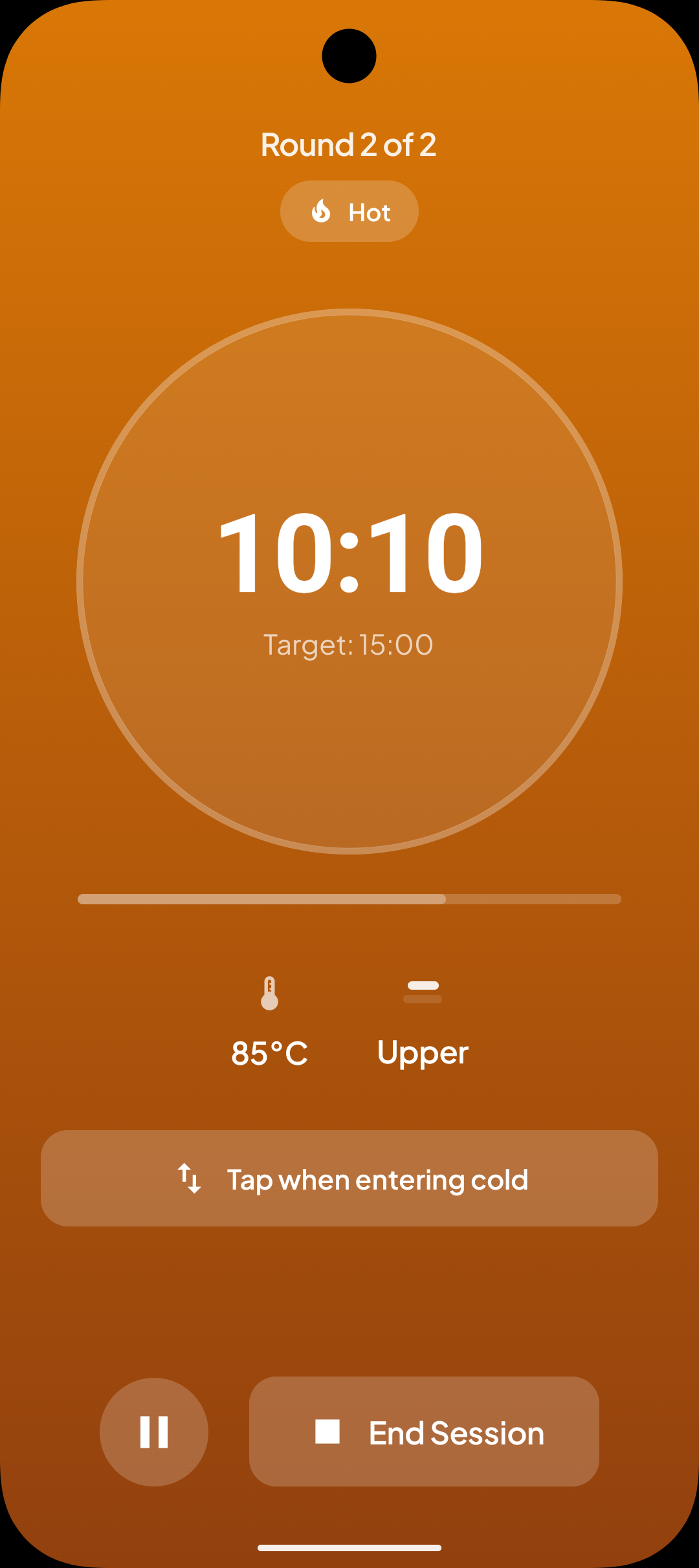
Using Altaflip to Time Your Sessions
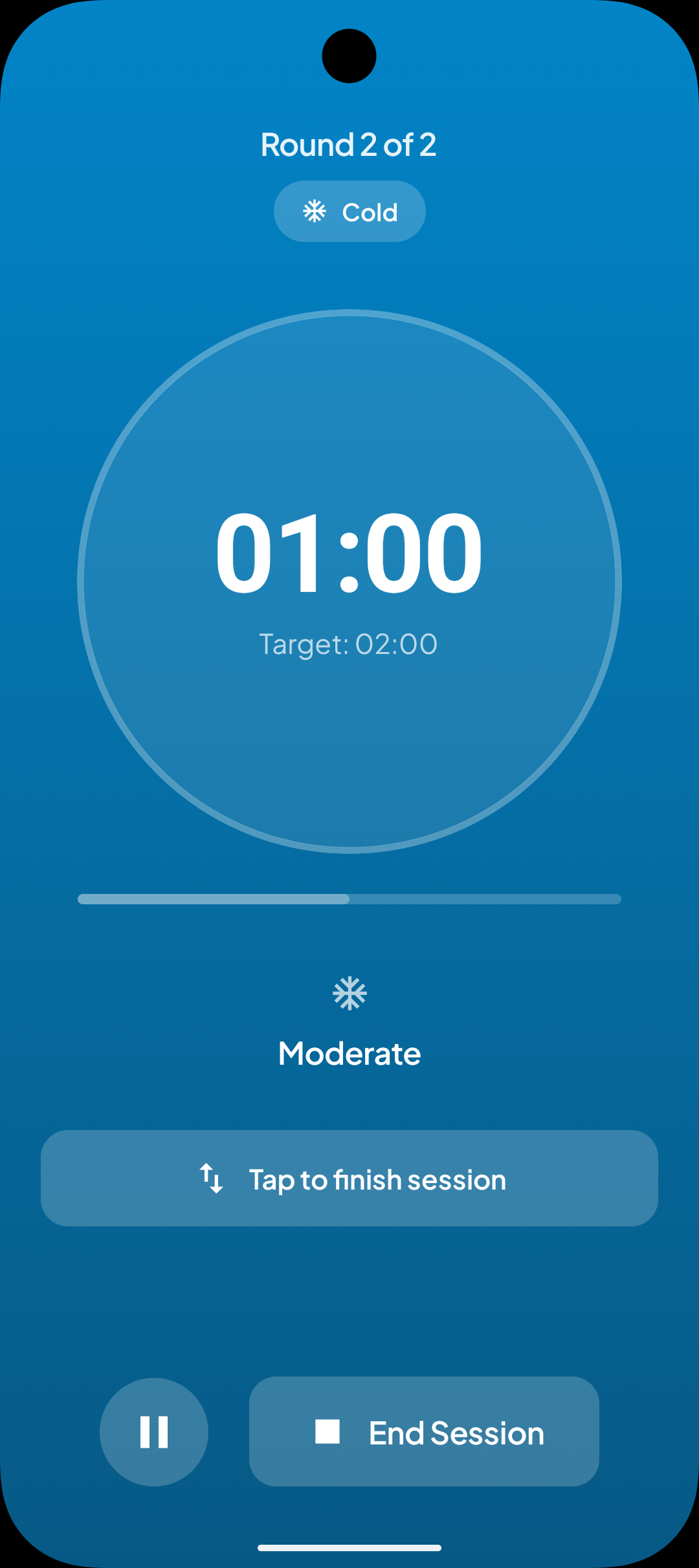
Altaflip's protocols include minimum session lengths, so you can see whether a session counts toward the routine you've chosen:
| Protocol | Minimum per session | Minimum temperature | Sessions per week |
|---|---|---|---|
| Beginner | 10 min | 65°C (149°F) | 2 to 3 |
| Deliberate Heat | 15 min | 80°C (176°F) | 3 to 5 |
| Finnish Longevity | 20 min | 80°C (176°F) | 4 to 7 |
The Finnish Longevity protocol's 20 minutes comes from the KIHD duration groups above: the top group was more than 19 minutes. The timer keeps running when your phone is locked, and your sweat estimate accounts for the onset delay, so a short session isn't credited with sweat you didn't produce.
The Bottom Line
For a traditional sauna, 5 to 20 minutes per round, repeated 1 to 3 times, covers what research describes as normal practice. Start short, build up gradually, and treat 15 to 20 minutes as a full round once you're used to the heat.
- Sweating starts several minutes in, so very short sessions do little
- More than 19 minutes was linked to fewer fatal cardiac events in Finnish men, but how often you go mattered more for overall mortality
- Infrared sessions run longer because the air is cooler; steam rooms are not as gentle as they look
- Rounds with cooling breaks are a safe way to get more total time in the heat
- Leave at the first sign of dizziness, nausea or confusion, whatever the clock says
Frequently Asked Questions
How long should a beginner stay in a sauna?
Start at the short end of the 5 to 20 minute range that sauna research describes: around 5 to 10 minutes per round, one or two rounds, on a lower bench. Add a few minutes per round over the following weeks as long as you feel fine. Get out early if you feel dizzy or unwell.
Is 20 minutes in a sauna enough?
For most people, 15 to 20 minutes in a traditional sauna is a full session. In the Finnish KIHD study, men whose sessions lasted more than 19 minutes had lower rates of fatal heart disease than men under 11 minutes, but that study was observational, and how often men used the sauna mattered more for overall mortality than how long they stayed.
How long should you stay in an infrared sauna?
Infrared saunas run cooler, roughly 45 to 60°C (113 to 140°F), and research protocols have used 15 to 30 minutes at about 60°C (140°F). Because the air is cooler, infrared sessions are usually longer than traditional ones. Leave early if you feel unwell.
How long should you stay in a steam room?
Treat a steam room as no gentler than a dry sauna. In one study of 10 men, core temperature rose more in a humid 59°C (138°F) sauna than in a dry 91°C (196°F) one over the same 3 x 15 minute protocol. Keep rounds short and leave at the first sign of feeling unwell.
Is 30 minutes in a sauna too long?
Thirty continuous minutes in a traditional sauna is longer than the 5 to 20 minute stays that reviews of sauna research describe. If you want more total time, splitting it into rounds with cooling breaks is the more common approach. In infrared saunas, 30 minutes is within the range researchers have used.
How many sauna rounds should you do?
Traditional practice and most research protocols use 1 to 3 rounds of 5 to 20 minutes with a cooling break between them. One large sweat-loss study used two 10 minute rounds at 90°C (194°F) with a 5 minute break.
Sources
- 1. Laukkanen, T., Khan, H., Zaccardi, F., & Laukkanen, J. A. (2015). Association between sauna bathing and fatal cardiovascular and all-cause mortality events. JAMA Internal Medicine, 175(4), 542-548. https://doi.org/10.1001/jamainternmed.2014.8187
- 2. Kukkonen-Harjula, K., & Kauppinen, K. (2006). Health effects and risks of sauna bathing. International Journal of Circumpolar Health, 65(3), 195-205. https://doi.org/10.3402/ijch.v65i3.18102
- 3. Hussain, J., & Cohen, M. (2018). Clinical effects of regular dry sauna bathing: A systematic review. Evidence-Based Complementary and Alternative Medicine, 2018, 1857413. https://doi.org/10.1155/2018/1857413
- 4. Laukkanen, J. A., & Kunutsor, S. K. (2024). The multifaceted benefits of passive heat therapies for extending the healthspan: A comprehensive review with a focus on Finnish sauna. Temperature, 11(1), 27-51. https://doi.org/10.1080/23328940.2023.2300623
- 5. Lee, J. B., Kim, T. W., Min, Y. K., & Yang, H. M. (2015). Seasonal acclimatization in summer versus winter to changes in the sweating response during passive heating in Korean young adult men. Korean Journal of Physiology & Pharmacology, 19(1), 9-14. https://doi.org/10.4196/kjpp.2015.19.1.9
- 6. Grucza, R., Lecroart, J. L., Hauser, J. J., & Houdas, Y. (1985). Dynamics of sweating in men and women during passive heating. European Journal of Applied Physiology and Occupational Physiology, 54(3), 309-314. https://doi.org/10.1007/BF00426151
- 7. Podstawski, R., Boraczyński, T., Boraczyński, M., Choszcz, D., Mańkowski, S., & Markowski, P. (2014). Sauna-induced body mass loss in young sedentary women and men. The Scientific World Journal, 2014, 307421. https://doi.org/10.1155/2014/307421
- 8. Podstawski, R., Borysławski, K., Józefacka, N. M., et al. (2024). The influence of extreme thermal stress on the physiological and psychological characteristics of young women who sporadically use the sauna: practical implications for the safe use of the sauna. Frontiers in Public Health, 11, 1303804. https://doi.org/10.3389/fpubh.2023.1303804
- 9. Pilch, W., Szygula, Z., Palka, T., et al. (2014). Comparison of physiological reactions and physiological strain in healthy men under heat stress in dry and steam heat saunas. Biology of Sport, 31(2), 145-149. https://pmc.ncbi.nlm.nih.gov/articles/PMC4042662/
- 10. Imamura, M., Biro, S., Kihara, T., et al. (2001). Repeated thermal therapy improves impaired vascular endothelial function in patients with coronary risk factors. Journal of the American College of Cardiology, 38(4), 1083-1088. https://doi.org/10.1016/s0735-1097(01)01467-x
- 11. Kauppinen, K. (1989). Sauna, shower, and ice water immersion. Physiological responses to brief exposures to heat, cool, and cold. Part I. Body fluid balance. Arctic Medical Research, 48(2), 55-63. PMID: 2736001
- 12. Hannuksela, M. L., & Ellahham, S. (2001). Benefits and risks of sauna bathing. The American Journal of Medicine, 110(2), 118-126. https://doi.org/10.1016/s0002-9343(00)00671-9
This article is for general information and is not medical advice. If you have a heart condition, high or low blood pressure, are pregnant or take regular medication, talk to your doctor before using a sauna or cold plunge.