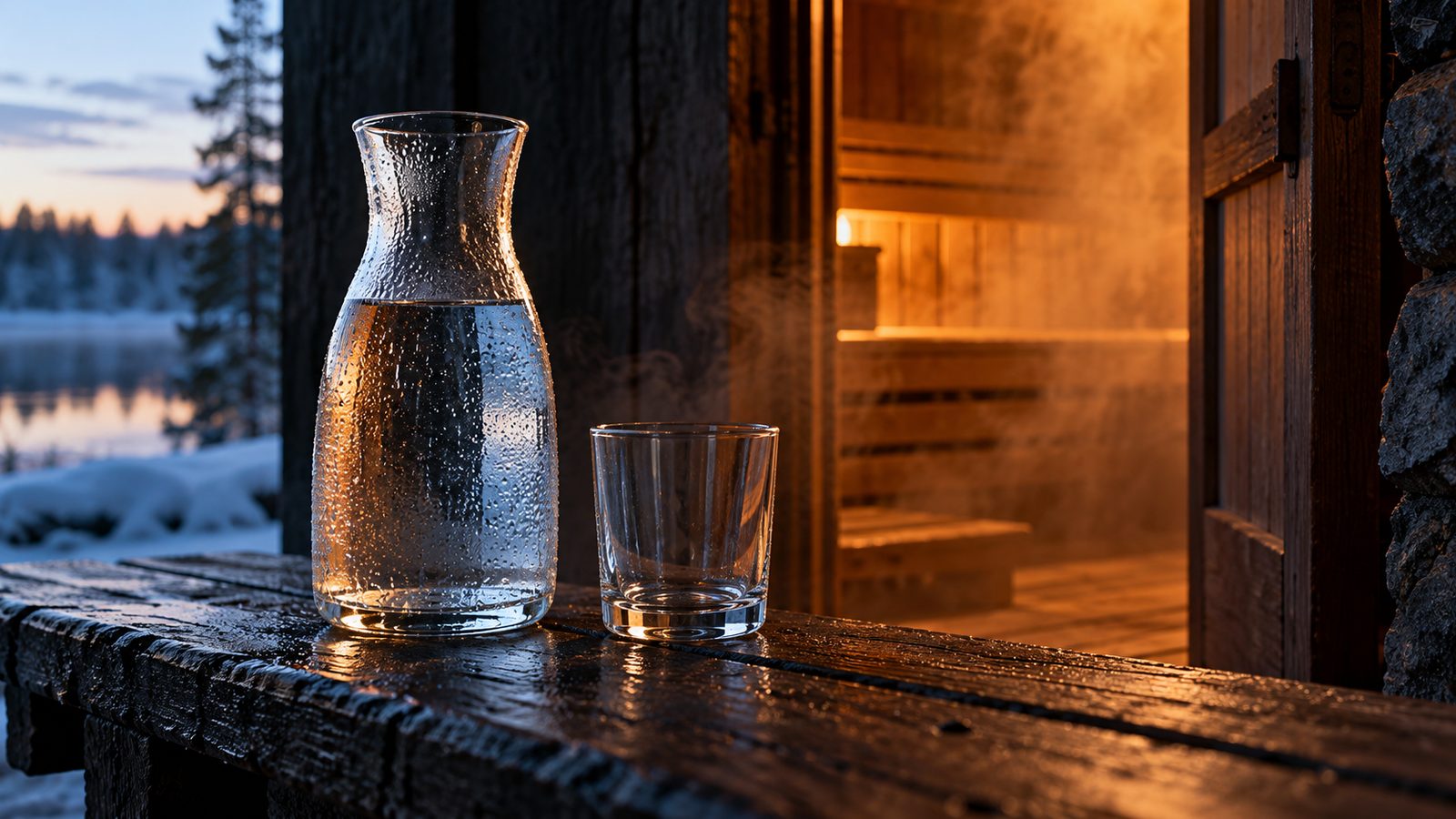
You've just finished a hot session and you're soaked. How much should you drink now, and does it matter what?
Get it wrong and you can be left with a headache, dizziness or a flat, tired feeling for the rest of the day. Here is what sports medicine guidelines say, applied to the sauna.
How Much Fluid a Sauna Costs You
In the largest study of sauna sweat loss, 674 young adults spent two 10-minute rounds in a 90°C (194°F) sauna. Men lost about 0.5 kg and women about 0.37 kg, nearly all of it sweat (Podstawski et al. 2014). For most people, then, a 20-minute session costs roughly 0.3 to 0.6 litres. Larger bodies, hotter rooms and longer or repeated rounds cost more. Our guide to how much you sweat in a sauna covers what changes the number.
Unlike exercise, where you can sip as you go, most of that loss happens in a short stretch with nothing to drink. You come out with a small deficit to repay. Sweat also carries sodium and a little potassium, which is why water alone is not always the whole answer after long sessions.
Signs You're Under-Hydrated
Common signs of dehydration include (McDermott et al. 2017):
- Thirst and a dry mouth
- Headache
- Dizziness or light-headedness, especially when you stand up
- Unusual tiredness or irritability
- Muscle cramps
- Dark yellow urine, or not needing to go for hours
If you feel dizzy, sick or confused during a session, get out, sit or lie down somewhere cool and drink. These can be early signs of heat illness.
Before, During and After
Before: Start Topped Up
Don't go in already dry. For activity in the heat, the American College of Sports Medicine suggests drinking about 5 to 7 ml per kg of body weight at least 4 hours before, slowly (Sawka et al. 2007). For a 70 kg adult that is about 350 to 500 ml, or two glasses. Drinking it early gives your body time to pass any excess before you sit down.
During: Between Rounds, Not On the Bench
Traditional sauna practice is to drink between rounds rather than on the bench. For a single session of 15 to 20 minutes, most people don't need to drink during it. If you're doing several rounds, a few sips during each break is sensible.
After: Drink More Than You Lost
Replacing exactly what you sweated out still leaves you short, because some of what you drink leaves as urine. The National Athletic Trainers' Association recommends replacing 100 to 150% of the fluid lost, towards the top of that range if you need to recover within a few hours. The American College of Sports Medicine puts it as about 1.5 litres for every kilogram lost (McDermott et al. 2017; Sawka et al. 2007).
Altaflip uses 150% of your estimated sweat loss as your target:
| Estimated sweat loss | Rehydration target (150%) |
|---|---|
| 300 ml | 450 ml |
| 500 ml | 750 ml |
| 750 ml | 1,150 ml |
| 1,000 ml | 1.5 L |
If you want precision, weigh yourself without clothes before and after the session, after towelling off. Each kilogram lost is about a litre.
Spread it out. Drink a large volume in one go and much of it comes straight back out as urine. Sipping steadily over the next 2 to 4 hours, ideally with some food or a little salt, helps your body hold on to it (Shirreffs & Sawka 2011).
When Do You Need Electrolytes?
For most sessions, plain water is enough. NATA's guidance is that activity lasting under an hour generally needs only water (McDermott et al. 2017).
Electrolytes or a salty snack start to make sense when:
- A session is long and you sweat heavily
- You do several rounds or sessions in a day
- You get muscle cramps, or you eat very little salt
Altaflip suggests considering electrolytes once a session runs past 30 minutes or you lose more than half a litre, and recommends them when a session runs past 45 minutes and you lose a litre or more. Those thresholds are the app's own conservative choice for intense passive heat, not a guideline.
What's in Your Sweat?
| Mineral | Typical amount in sweat | Source |
|---|---|---|
| Sodium | about 230 to 2,070 mg per litre, average about 825 mg | Baker 2017; Baker et al. 2016 |
| Potassium | about 78 to 313 mg per litre | Baker 2019 |
| Magnesium | about 0.5 to 10 mg per litre | Baker 2019 |
Sodium is the one that matters. At an average concentration, 500 ml of sweat carries roughly 400 mg of sodium, but saltier sweaters can lose more than twice that.
Simple options: a salty snack with your water (crackers, olives, pickles), a small pinch of salt in a glass of water, or an electrolyte drink. Sodium helps your body keep the fluid you drink rather than passing it straight out (Shirreffs & Sawka 2011).
One Public Example: Bryan Johnson
Bryan Johnson, who publishes his "Blueprint" longevity routine, describes a daily 20-minute sauna at 200°F (93°C), followed by about 36 oz (roughly 1 litre) of mineral-supplemented water (Johnson, Blueprint). That is more than most people lose in 20 minutes and in line with the 150% principle. He has no connection to Altaflip; it is just a well-known routine that takes rehydration seriously.
Your Daily Water Goal on Sauna Days
On sauna days, add your rehydration target on top of what you normally drink.
Altaflip starts your daily goal at 33 ml per kg of body weight (you can set your own) and adds each session's rehydration target to it. For a 75 kg person that is about 2.5 L, plus 750 ml after a session that cost 500 ml of sweat: about 3.25 L for the day. For comparison, Europe's reference values for total water intake, from drinks and food combined, are 2.0 L a day for women and 2.5 L for men (EFSA 2010), so the app's default leans generous.
Common Mistakes
Chugging It All at Once
Down a litre straight after the session and much of it is passed as urine rather than kept. Sip steadily instead.
Drinking Alcohol Before or During
Alcohol and sauna heat both lower blood pressure, and together they raise the risk of fainting, falls and heart rhythm problems (Ylikahri et al. 1988). In a review of sauna deaths in Finland, about half of the people who died had alcohol in their blood (Kenttämies & Karkola 2008).
After the sauna, a small, low-alcohol drink once you've had water is a different matter. In one study, drinks up to 2% alcohol made no difference to rehydration, while a 4% drink, about regular beer strength, tended to slow it (Shirreffs & Maughan 1997), so have your water first.
Forgetting Salt on Long, Multi-Round Days
If you do several rounds or a long contrast session, water alone may leave you feeling washed out. Add a salty snack or an electrolyte drink.
Relying Only on Urine Colour
Dark urine is a useful warning sign, but pale urine straight after drinking a lot doesn't mean you're fully topped up. Look at the whole picture: thirst, headache, energy, and how you feel standing up.
A Simple Post-Sauna Routine
Right after (first 30 minutes):
- 250 to 500 ml of water, sipped
- Add a salty snack or electrolytes if it was a long, heavy-sweat session
Over the next 2 to 4 hours:
- Keep sipping until you reach about 1.5 times what you lost
- Eat a normal meal, which brings salt and more water with it
For the rest of the day:
- Back to your normal drinking
- Pale yellow urine and no headache are good signs
Stay Safe
If you have a heart condition, low or high blood pressure, kidney problems, are pregnant, or take medication that affects fluid balance (such as diuretics), talk to your doctor about sauna use and how much to drink.
The Bottom Line
- Start topped up: a glass or two of water a few hours before
- Replace up to 150% of what you lose, because some of it leaves as urine
- Sip it over 2 to 4 hours, not all at once
- Add salt or electrolytes after long, heavy-sweat sessions or several rounds
- Skip alcohol before and during, and have water before any drink after
Getting this right means fewer post-sauna headaches and feeling better for the rest of the day.
Frequently Asked Questions
How much water should I drink after a sauna?
Aim for up to 1.5 times the fluid you lost. For a typical 20-minute session that is about 450 to 900 ml, depending on your size and the heat. Sip it over the next few hours rather than all at once.
Can you drink water during a sauna?
Yes. Traditional practice is to drink between rounds rather than on the bench, and for a single short session most people don't need to. If you are doing long or repeated rounds, a few sips between them is sensible.
What are the signs of dehydration after a sauna?
Thirst, headache, dizziness when you stand up, unusual tiredness, muscle cramps and dark urine. If you feel dizzy, sick or confused in the sauna, get out, cool down and drink.
Do I need electrolytes after a sauna?
Usually not. For under an hour of activity, sports medicine guidelines say water is enough. Electrolytes or a salty snack make sense after long sessions with heavy sweating, several rounds in a day, or if you get cramps.
How long before a sauna should I drink water?
Drink normally through the day, and have a glass or two of water a few hours before. The American College of Sports Medicine suggests about 5 to 7 ml per kg of body weight at least 4 hours before activity in the heat, which is about 350 to 500 ml for a 70 kg adult.
Is beer after a sauna bad for hydration?
A small, low-alcohol beer after you have rehydrated with water is unlikely to matter much: in one study, drinks up to 2% alcohol made no difference, while a 4% drink, about regular beer strength, tended to slow rehydration. Avoid alcohol before and during a sauna, when it raises the risk of fainting and heart rhythm problems.
Sources
- 1. McDermott, B. P., Anderson, S. A., Armstrong, L. E., et al. (2017). National Athletic Trainers' Association position statement: fluid replacement for the physically active. Journal of Athletic Training, 52(9), 877-895. https://doi.org/10.4085/1062-6050-52.9.02
- 2. Sawka, M. N., Burke, L. M., Eichner, E. R., et al. (2007). American College of Sports Medicine position stand: Exercise and fluid replacement. Medicine & Science in Sports & Exercise, 39(2), 377-390. https://doi.org/10.1249/mss.0b013e31802ca597
- 3. Podstawski, R., Boraczyński, T., Boraczyński, M., Choszcz, D., Mańkowski, S., & Markowski, P. (2014). Sauna-induced body mass loss in young sedentary women and men. The Scientific World Journal, 2014, 307421. https://doi.org/10.1155/2014/307421
- 4. Shirreffs, S. M., & Sawka, M. N. (2011). Fluid and electrolyte needs for training, competition, and recovery. Journal of Sports Sciences, 29(Suppl 1), S39-S46. https://doi.org/10.1080/02640414.2011.614269
- 5. Shirreffs, S. M., & Maughan, R. J. (1997). Restoration of fluid balance after exercise-induced dehydration: effects of alcohol consumption. Journal of Applied Physiology, 83(4), 1152-1158. https://doi.org/10.1152/jappl.1997.83.4.1152
- 6. Baker, L. B. (2017). Sweating rate and sweat sodium concentration in athletes: a review of methodology and intra/interindividual variability. Sports Medicine, 47(Suppl 1), 111-128. https://doi.org/10.1007/s40279-017-0691-5
- 7. Baker, L. B., Barnes, K. A., Anderson, M. L., Passe, D. H., & Stofan, J. R. (2016). Normative data for regional sweat sodium concentration and whole-body sweating rate in athletes. Journal of Sports Sciences, 34(4), 358-368. https://doi.org/10.1080/02640414.2015.1055291
- 8. Baker, L. B. (2019). Physiology of sweat gland function: the roles of sweating and sweat composition in human health. Temperature, 6(3), 211-259. https://doi.org/10.1080/23328940.2019.1632145
- 9. EFSA Panel on Dietetic Products, Nutrition, and Allergies (2010). Scientific opinion on dietary reference values for water. EFSA Journal, 8(3), 1459. https://doi.org/10.2903/j.efsa.2010.1459
- 10. Kenttämies, A., & Karkola, K. (2008). Death in sauna. Journal of Forensic Sciences, 53(3), 724-729. https://doi.org/10.1111/j.1556-4029.2008.00703.x
- 11. Ylikahri, R., Heikkonen, E., & Soukas, A. (1988). The sauna and alcohol. Annals of Clinical Research, 20(4), 287-291.
- 12. Johnson, B. What to Look for in a Sauna. Blueprint. https://blueprint.bryanjohnson.com/blogs/news/what-to-look-for-in-a-sauna
This article is for general information and is not medical advice. If you have a heart condition, high or low blood pressure, are pregnant or take regular medication, talk to your doctor before using a sauna or cold plunge.